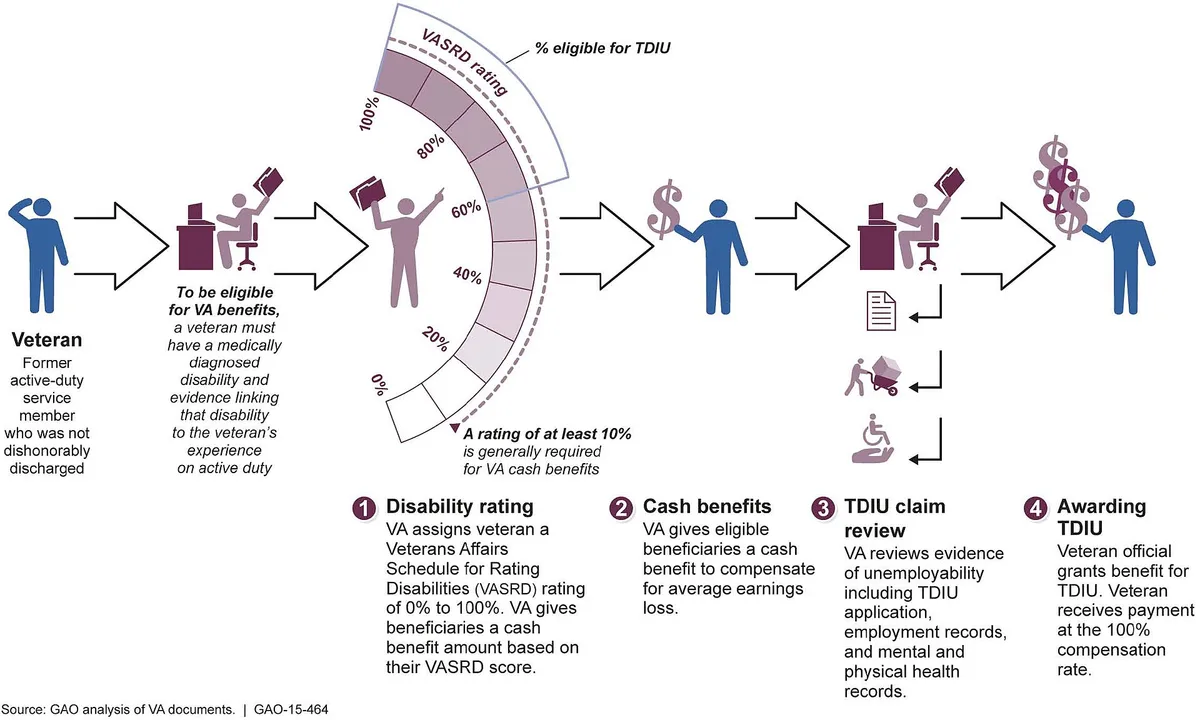
A VA disability rating is VA's percentage estimate of how much a service-connected condition reduces a veteran's average earning capacity. Ratings run from 0 to 100 percent, in 10 percent increments, under published VA rating rules. The percentage drives the monthly compensation payment, so how VA combines multiple ratings matters as much as any single rating.
The most common point of confusion is arithmetic. VA does not add ratings together. Two 50 percent ratings produce a combined rating of 80 percent, not 100 percent, under VA's published combining method. This piece walks through the rating schedule, the combined ratings table, and the bilateral factor, using VA's own guidance as the reference. For a broader look at the money behind the claims system, see the Pentagon Times coverage of the VA disability claims process and the fiscal 2027 budget request. This connects to our earlier piece, VA Disability Claims Process Meets a $488.2 Billion Fiscal 2027 Budget Request.
What is a VA disability rating?
A rating is VA's measurement of severity, expressed as a percentage. VA assigns it after a veteran files a claim for a condition linked to military service. The percentage sits on a single schedule VA publishes in its regulations, and each percentage level carries a monthly payment amount that VA updates in its published benefit rate tables.
VA can also assign a 0 percent rating, called a non-compensable rating. That rating establishes the condition as service connected without producing a payment. It still matters: if the condition worsens later, the record already exists, and the veteran can ask VA to re-evaluate it.
One rating applies per condition, and a veteran may hold ratings for several conditions at once. That is where the combining rules come in. The Veterans Benefits Administration publishes the compensation rules, evidence requirements, and rate tables that govern the whole process.
How does VA assign a percentage to a condition?
VA rates each condition against a set of criteria in its schedule of ratings. For most conditions, the criteria describe measurable things: range of motion in a joint, frequency and severity of symptoms, episodes of illness, or the level of daily function a veteran retains. The examining clinician documents those findings, and a VA rating specialist, called a rating veterans service representative, matches the findings to a percentage level on the schedule.
The schedule is deliberately discrete. A condition does not get a 43 percent rating; it gets the listed level its findings support, typically 0, 10, 20, 30, 40, 50, 60, or 100 percent depending on the condition. If findings fall between two levels, VA assigns the lower one, because the higher level requires meeting all of its criteria.
Some severe outcomes carry their own rules. Loss of a limb, loss of use of an organ or extremity, and certain combinations of severe service-connected disabilities can produce the statutory maximum of 100 percent without the combined-ratings arithmetic described below. VA's published guidance describes these special rating provisions separately from the ordinary schedule.
Why doesn't VA just add ratings together?
Because VA rates the whole person, not each condition in isolation. The published method treats a veteran as starting at 100 percent efficiency, or capacity. Each rating removes its percentage of what capacity remains, not of the original whole. VA applies the same reasoning in its own published guidance on how it combines multiple ratings.
A worked example shows the effect. A veteran has one 50 percent rating. That leaves 50 percent efficiency. A second 50 percent rating removes half of what remains, or 25 percent. The combined efficiency is now 25 percent, which makes the combined rating 75 percent. VA rounds the final combined figure to the nearest 10 percent, so 75 rounds to 80.
This is the whole-person concept at work. The second condition is rated against a body that is already diminished by the first. The approach also explains why stacking many moderate ratings rarely reaches 100 percent: each new percentage acts on a smaller and smaller remainder. A veteran at a combined 90 percent has only 10 percent efficiency left, so even a substantial new rating moves the combined figure by a small amount.
VA publishes a combined ratings table so veterans can run the math themselves. The table lists ratings in descending order; the veteran takes the first rating, finds it in the table, reads across to the second rating, and gets a preliminary combined figure. With three or more ratings, the process repeats, using each new result against the next rating until all conditions are folded in. The final figure is rounded to the nearest whole 10 percent.
What is the bilateral factor?
The bilateral factor is an adjustment VA applies when a veteran has service-connected ratings affecting both arms, or both legs, or the skeletal muscle groups of paired extremities. Under VA's published rules, when combining such paired ratings, VA multiplies the combined value of the bilateral conditions by an additional 10 percent before folding the result into the rest of the calculation.
The rationale is functional. Two paired limbs rarely fail independently; a bad right knee changes how a left knee carries weight, and VA's rules recognize that paired disabilities degrade capacity together. The factor applies only to the bilateral group, not to the veteran's entire set of ratings.
The mechanics run in a fixed order. First, VA combines the ratings for the paired extremities. Second, VA adds the 10 percent bilateral factor to that combined value. Third, VA uses that adjusted figure as one rating and combines it with every remaining rating through the ordinary combined ratings table. The result is rounded to the nearest 10 percent at the end, once.
What this means in practice is that bilateral veterans see a modestly higher combined rating than the plain table would produce, but the effect is proportional to how much of the overall rating comes from the paired conditions. It does not apply to conditions on one side only, and it does not apply to non-paired conditions such as hearing loss or a back condition.
What this means for veterans reading their rating decision
Every rating decision VA issues lists each condition, its individual percentage, and the combined rating. Checking the math is straightforward once the method is known: order the individual ratings, apply the bilateral factor if paired extremities are involved, run the combined table, and round once at the end. A combined figure that matches the arithmetic confirms the decision's internal consistency; one that does not is worth a clarifying question to VA or an accredited representative.
Two practical points follow from the structure. First, a single disabling condition rated at 100 percent is paid as totally disabled regardless of arithmetic, which is why severe single-condition cases bypass the table. Second, because combined ratings approach 100 percent asymptotically, veterans with many moderate ratings should expect each new rating to move the total less than intuition suggests.
Where a rating comes back lower than the evidence supports, the remedy is the appeals process, which the Pentagon Times explains step by step in its guide to how the VA appeals process works after a denied claim. Rating outcomes also interact with other VA programs: a disability rating factors into health care enrollment priority, which is covered in the explainer on VA health care eligibility and priority groups. More VA benefits coverage sits on the site's veterans desk. Readers following this should also see VA Health Care Eligibility Explained: Priority Groups, Service Minimums, and Enrollment.
What remains genuinely variable is the evidence in any individual file. The schedule and the combining rules are fixed and published; the percentage a veteran receives depends entirely on the documented findings VA can attribute to service. That is why the claim record, not the arithmetic, is usually where outcomes are decided.