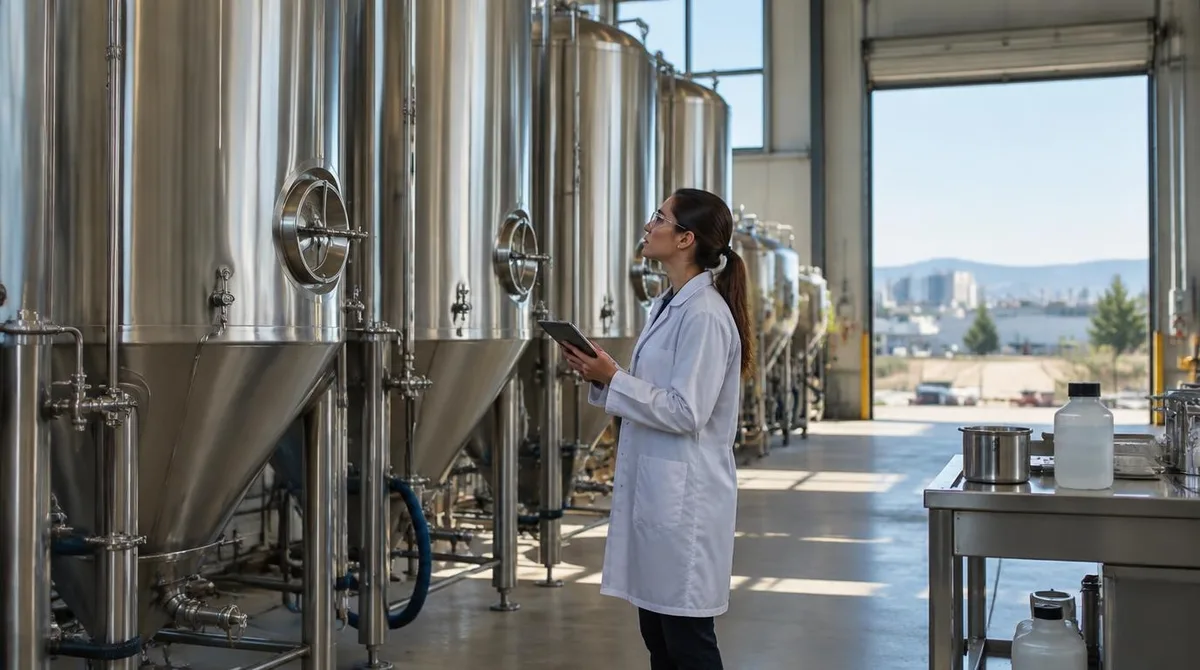
The Pentagon has awarded $21 million to Biosphere, a California-based biotech startup, to build a 20,000-liter facility where genetically engineered microbes will produce chemicals for military supplies. The facility is slated for commissioning in the fourth quarter of 2027, per the company's announcement reported by Breaking Defense. At 20,000 liters, it ranks among the largest Defense-funded bio factories to date.
For readers tracking defense supply-chain spending, the award is a concrete data point in a wider Pentagon push to rebuild domestic production of vital components and chemicals that moved offshore, especially to China. It also follows an earlier Pentagon award to Biosphere, worth up to $9 million if all options are exercised, for a portable, electrically powered bio-brewery that makes protein out of water and air. Both awards sit inside a broader effort that spans traditional industry rebuilds and emerging technologies like biomanufacturing, a field covered across Government News and on the site's defense desk. Readers following this should also see GAO Finds DOGE Wall of Receipts Savings Claims Unsupported, Including Pentagon Contract.
What is biomanufacturing, and why does the military want it?
Biomanufacturing uses vats of microorganisms, genetically engineered to produce a desired substance. Breaking Defense describes it as essentially a high-tech version of how breweries use yeast to turn grain into alcohol. The approach is technologically trickier than traditional industrial chemistry in some ways: Biosphere, for instance, uses UV light to sterilize miles of piping so the wrong microorganisms do not grow by mistake.
The payoff, per the reporting, is that biomanufacturing can produce things petrochemistry cannot, or produce the same things with less energy consumption and pollution. To date the field has been used overwhelmingly by the pharmaceuticals industry, which has built massive facilities in the US and abroad. But it is increasingly possible to make microbes brew chemical ingredients of interest to the military, from high explosives to anti-corrosion coatings.
What will the new facility actually make?
Potential products range from a "bio-cement" mixture, which turns loose sand into solid landing surfaces for helicopters, to polymer-bonded explosives (PBX) for weapons like the Hellfire missile, CEO Brian Heligman told Breaking Defense. He declined to disclose more specifics but said the company has had "detailed discussions around two or three fine chemicals" that fit the facility and the government's stated priorities.
The projected output is about 100 tons of chemicals a year. Heligman said that is tiny compared with an industrial petrochemical plant making bulk plastics, but ten times the size of the 1,000-liter systems now standard in military labs for brewing experimental batches. He called the mid-sized scale a "sweet spot" for defense needs: enough volume for munitions and other military programs, without the overhead of a bulk-manufacturing facility.
"They don't need massive-scale, commodity-plastic volumes," Heligman said of the military. "A small, specialty-chemical production line is a useful asset for them."
Why the Pentagon struggles to buy these chemicals
The military needs a lot of bespoke chemicals, such as the advanced energetics used in explosive warheads, for which there is little civilian demand. Right now, Pentagon demand is high as the military rushes to restock munitions expended against Iran. But funding for energetics has historically seen dramatic peaks and valleys, per the reporting.
Those two factors make it hard to convince traditional chemical manufacturers to invest in US production capacity for these critical chemicals. Both industry and government officials lamented the problem Tuesday at a Hudson Institute conference, according to Breaking Defense. A small specialty producer like Biosphere is positioned to fill exactly that gap.
What happens next, and what to watch
Three checkpoints follow from the supplied record:
- Commissioning: the $21 million facility is slated for the fourth quarter of 2027. Any slip past that date will be measurable against this stated baseline.
- Product disclosure: Heligman has named only bio-cement and PBX so far. The "two or three fine chemicals" under discussion remain undisclosed.
- Scale-up signals: Heligman said the company is using the facility as a demonstration asset to show its cost advantage translates to very large facilities, citing rapid advances in genetic engineering and AI simulation of biological processes.
The policy backdrop matters for readers following the money. Pentagon Chief Technology Officer Emil Michael elevated biomanufacturing to one of his top six Critical Technology Areas last year, even as he downgraded other priorities. How that priority survives budget cycles, including the current stopgap fights covered in the site's fall 2026 appropriations coverage, will shape whether follow-on awards materialize. We covered a connected angle in Defense Appropriations Enter Fall 2026 on a Stopgap: What Happens Next.
What remains unknown: the specific chemicals beyond the two named product categories, the contract's option structure beyond what was reported, and whether the 2027 commissioning date holds. The department has not published additional product details.