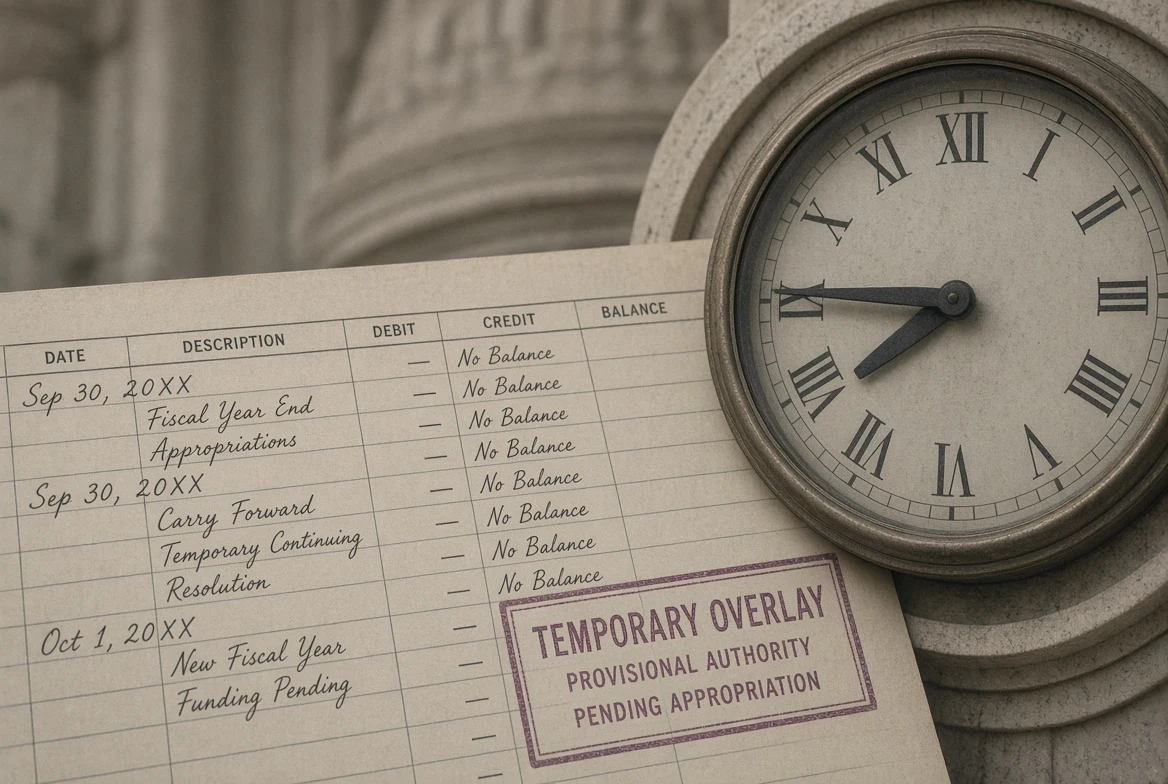
A continuing resolution (CR) is a temporary spending law that keeps the government funded at prior-year rates when Congress has not passed a full appropriations bill by the deadline. It does not give the Pentagon new money for new programs. It holds the department close to where it was, while lawmakers negotiate the real bill.
The word itself carries the legal meaning. As Vocabulary.com notes, something described as continuing is "remaining in force or being carried on without letup," and its example sentence — "the act provided a continuing annual appropriation" — is close to how a CR works in practice: an appropriation that simply keeps running until Congress replaces it.
That simple mechanism has large consequences. Under a CR, the Pentagon can pay salaries, fund training, and keep existing contracts moving. What it largely cannot do is start new programs, raise production rates above last year's plan, or launch initiatives Congress has not yet reviewed. The department runs, but it runs on autopilot. This explainer walks through what a CR funds, what it freezes, and why defense officials treat long ones as a budget problem rather than a routine pause.
What does a continuing resolution actually do?
A CR extends spending authority for a fixed stretch of time, usually until a set date or until Congress enacts the full-year bills. It generally holds each account at its prior-year rate, sometimes with small adjustments written into the text. The point is continuity, not policy: the CR keeps money flowing so agencies do not shut down, and it avoids making new spending decisions before lawmakers have agreed on them.
For the Pentagon, that means the department operates under last year's numbers while its current budget request sits unresolved in Congress. The mechanics sit inside a larger process — Congress must both authorize defense programs and then appropriate the money for them, a split explained in the site's piece on authorization versus appropriation. A CR only touches the money half. It cannot authorize a new program, extend an expiring authority, or change acquisition policy on its own.
What keeps running under a CR?
The core functions keep running. Military and civilian payroll continues, because paying the force is an existing obligation at an existing rate. Training, maintenance, and ongoing operations continue at roughly prior-year levels. Contracts awarded before the CR took effect continue to be paid, because the government is obligated to honor them.
Day-to-day management also continues. The department can still plan, still submit its budget materials, and still work with Congress on the pending bills. What changes is the pace of new decisions. Acquisition officials become cautious about signing anything that depends on money a CR has not provided, because spending ahead of an appropriation can create a legal problem known as an Antideficiency Act violation — spending or obligating funds Congress has not made available. Under a CR, that risk sits at the front of every contracting decision.
What does a CR stop or delay?
The freeze falls mainly on new activity. New program starts generally wait, because a CR funds accounts at prior-year rates and a brand-new program had no prior-year rate to inherit. Production rate increases wait, for the same reason: a CR typically holds spending near the prior year's level, not the higher level the new budget requested. Large multiyear procurement decisions and new contract awards also slow, since officials hesitate to obligate money the CR has not clearly made available.
Research, development, and military construction feel the delay in different ways. New development efforts stall, and construction projects that were not already funded wait for the full bill. The site's explainer on how military construction budgeting works shows why: a project moves from an installation need to a funded line through a deliberate process, and a CR interrupts the funded end of that process. None of this means the money disappears. It means the decisions slip until the full-year appropriations act arrives. We covered a connected angle in How Military Construction Budgeting Works, From Installation Need to Funded Project.
What are anomalies, and why do they matter?
An anomaly is a carve-out. When Congress writes a CR, it can single out specific accounts or programs and fund them differently from the general prior-year rate — higher, lower, or at a specified amount. The stated purpose is usually to prevent a specific harm the flat rate would cause, such as breaking a production line or leaving a critical initiative unfunded mid-stream.
Anomalies are the exception, not the rule, and each one is a deliberate legislative choice that appears in the CR text itself. For readers tracking a specific program, the practical step is to read the CR language: the general rule is prior-year rates, and anything funded differently is listed as an exception. Programs without an anomaly wait for the full bill. That is the whole game — the CR's default is continuity, and every deviation has to be written down.
Why do longer CRs cause bigger problems?
The shorter a CR, the smaller the distortion. A few weeks of flat funding mostly means deferred paperwork and cautious contracting. A CR that stretches for months does something different: it forces the department to execute a full-year plan built on prior-year assumptions, while the services delay or compress the decisions a real budget would have allowed. Programs can slip not because anyone canceled them, but because the funding decisions that would have moved them forward never arrived in time.
Planning suffers too. The Pentagon builds its spending strategy through the Program Objective Memorandum (POM), the internal five-year plan described in the site's POM explainer. When the enacted budget arrives late and different from what was planned, the services have to re-balance accounts they had already mapped out. The longer the CR, the more of that planning year is spent executing a budget nobody chose. For related coverage, see POM Explained: How the Pentagon Builds Its Five-Year Defense Spending Plan.
What this means for readers: a CR is not a shutdown and not a budget. It is a holding pattern with a known default — last year's rates — and a known cost, which is time. The programs that move during a CR are the ones Congress chose to exempt. Everything else waits.
Where a CR fits in the spending calendar
The CR exists because the appropriations calendar and the legislative calendar do not always line up. The fiscal year begins in the fall, and the full-year defense bill is supposed to be enacted by then. When it is not, a CR bridges the gap. The site's walkthrough of how the defense authorization timeline works covers the parallel track: authorization bills move on their own schedule, and appropriations can lag behind them.
The evidence for how a specific CR treated specific programs sits in the CR text and the committee reports accompanying it, not in general descriptions. Each CR is a separate law with its own duration, its own rate-setting language, and its own list of anomalies. The department's response is also documented in its own budget materials, which explain how execution changes under CR conditions. What no general explainer can supply is the current status: which CR is in effect, how long it runs, and what it exempts. That information changes with each law, and it lives in the documents themselves.
The takeaway is structural. A continuing resolution holds spending at prior-year rates, funds the ongoing force, freezes most new starts, and moves only the programs Congress explicitly exempts. Everything else — the schedule, the production lines, the new initiatives — waits for the full-year bill that the CR was written to replace.