The National Defense Authorization Act (NDAA) authorizes appropriations for the Department of Defense, nuclear weapons programs of the Department of Energy, and other defense-related activities — but does not itself provide budget authority, per the Congressional Research Service. Fiscal 2025 marked the 64th consecutive fiscal year with an enacted defense authorization, the CRS primer dated December 4, 2025 records.
What does the NDAA actually do?
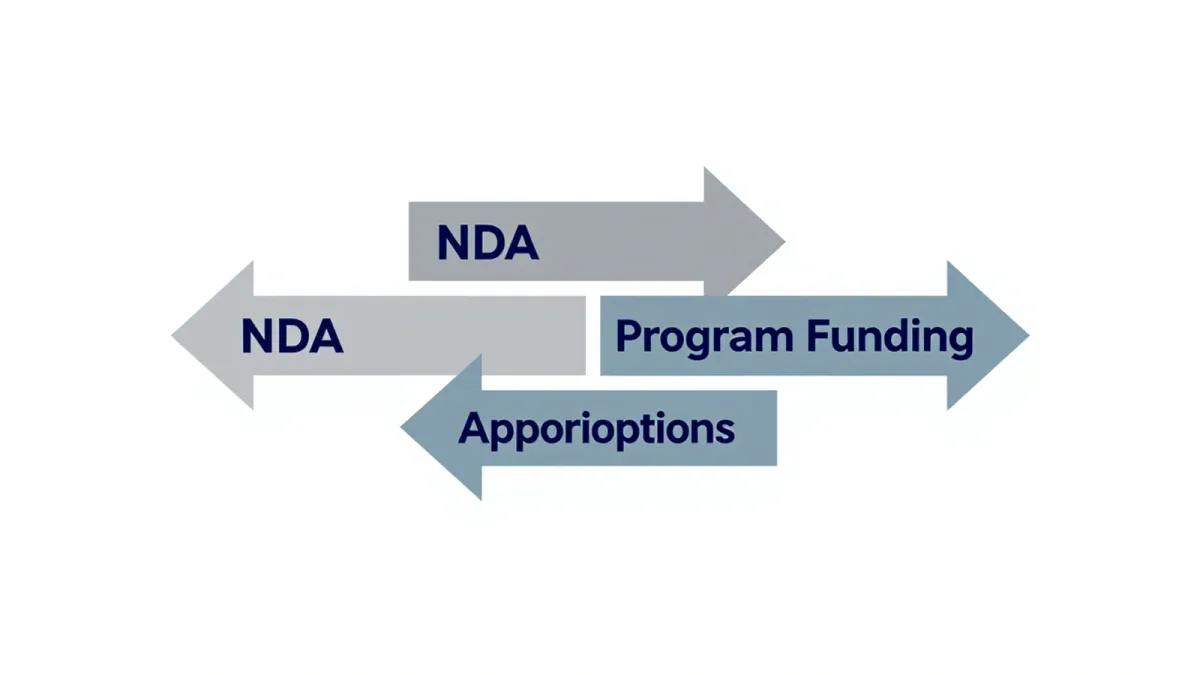
Two things, and the distinction is the heart of the process. "In addition to serving as an authorization of appropriations, the NDAA establishes defense policies and restrictions, and addresses organizational administrative matters related to the DOD," per CRS In Focus IF10515. "Unlike an appropriations bill, the NDAA does not provide budget authority for government activities. Nevertheless, historically it has provided a fairly reliable indicator of congressional sentiment on subsequent appropriations for particular programs."
The House and Senate Armed Services Committees hold exclusive jurisdiction over the bill in their chambers. The authorization sets ceilings and policies — force structure, pay raises, weapons programs, management reform — while the appropriations committees decide later, in separate bills, how much cash actually moves. The CRS retrospective of the two-track system tabulates authorization bills every fiscal year from FY1961 forward, with introduction dates, final passage dates, and public law numbers.
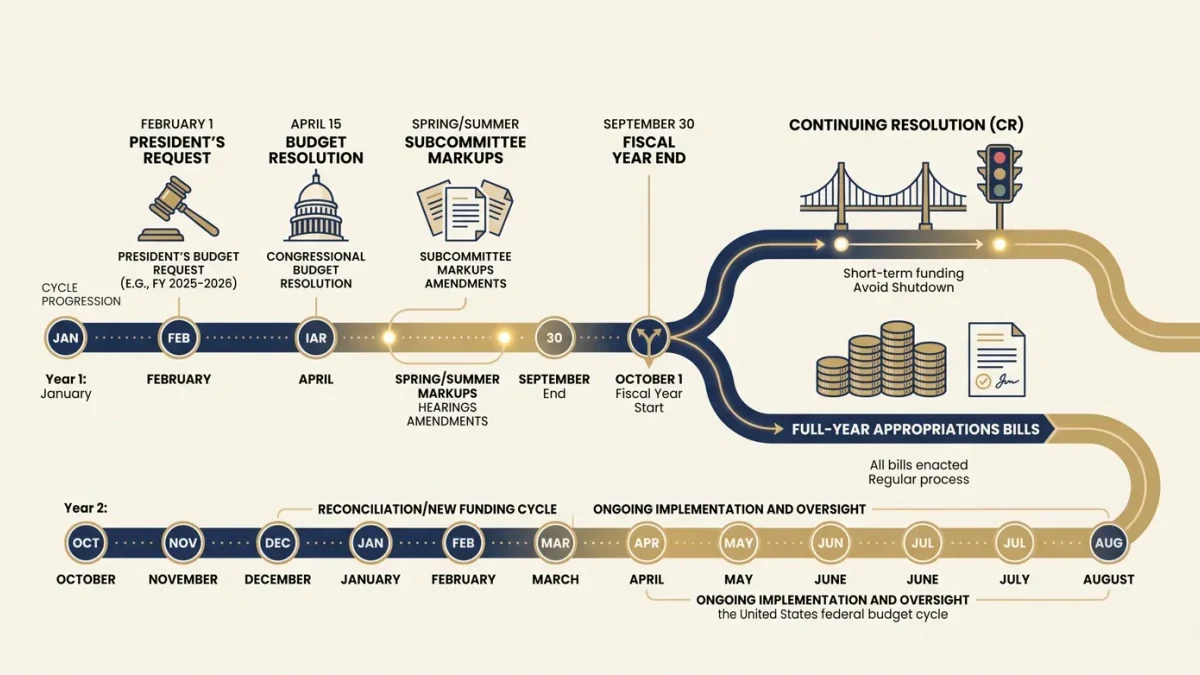
How does the annual timeline run?
- The President's budget request reaches Congress early in the calendar year, opening the authorization cycle.
- The armed services committees hold hearings and mark up their versions of the NDAA — the House traditionally first, in spring.
- Each chamber passes its own bill and sends it to the other.
- Differences are resolved, historically through conference, producing a single text.
- The compromise passes both chambers and is signed into law, ideally before the fiscal year begins October 1.
The schedule holds because the stakes are institutional. As the CRS primer puts it, the streak of more than six decades of enactment "depends upon adherence to process and consistency in procedures, schedules, and protocols." When authorization slips past the fiscal year boundary, the policy baseline carries over while appropriations — or a continuing resolution — keep money flowing.
Why has it passed every year since the early 1960s?
Because both parties treat it as must-pass machinery, not a hostage. The bill carries service members' pay authorities, weapons program permissions, and management directives; failing to enact it stalls all of them at once. The long-run record is tabulated in CRS's retrospective of authorization and appropriations bills, "Defense Authorization and Appropriations Bills: FY1961-FY2021," which compiles the public-law series across six decades, per CRS report 98-756. The report's tables run from the authorization bills of the 1960s through fiscal 2021, and CRS noted it would be updated as legislative activity warranted — a series that has since run past its printed horizon.
Who writes the bill, committee by committee?
Jurisdiction is the first fact of the process. "The House Committee on Armed Services (also known as the House Armed Services Committee, or HASC) and the Senate Committee on Armed Services (also known as the Senate Armed Services Committee, or SASC) have jurisdiction," the CRS primer states. No other committee can report an NDAA; every provision in the final law — from a submarine's procurement ceiling to a personnel policy — passed through one of those two markup rooms first.
Markup is where the bill is really built. Committee members file proposals, the chairman's mark assembles them into a base text, and the committee amends that text line by line before reporting it to the floor. The same sequence runs in both chambers, on the same underlying budget request, which is why the two bills emerge similar in structure but different in detail — and why the resolution of those differences, historically in conference, is where the final policy is settled. The CRS primer's central observation is that the reliability of enactment across 64 fiscal years "depends upon adherence to process and consistency in procedures, schedules, and protocols," not on any guarantee in law.
Why is the authorization separate from the money?
Because Congress built the budget in two tracks, and defense is the domain where the two-track design is most visible. The authorization bill creates or sustains programs and sets the ceilings they may be funded to; the appropriations bill then provides the budget authority — the actual cash. CRS's retrospective of the two-track record, covering authorization and appropriations bills from fiscal 1961 through fiscal 2021, tabulates both series side by side, and the pairing is the point: an authorized program with no appropriation is a policy statement, while an appropriation for an unauthorized program is the anomaly the two-track design exists to flag.
The primer's warning against conflating the tracks is explicit: the NDAA "does not provide budget authority for government activities," yet it "has provided a fairly reliable indicator of congressional sentiment on subsequent appropriations for particular programs." In practice, that means program managers watch the authorization numbers as a forecast of the money — accurate often enough to plan around, but not the money itself.
What do the CRS tables show about how long each step takes?
The retrospective report is built for exactly that question. Its tables compile, for every authorization bill from fiscal 1961 onward, the dates bills were introduced, substitutions adopted, dates of final passage in each chamber, and the public law numbers of the enacted results. Read as a series, the tables show the two chambers moving on their own clocks — the House voting its version, the Senate amending and voting its own, and the final text bearing one public law number once the differences were resolved and the President signed.
Two cautions come with the series. First, the tables record the authorization track only; the companion appropriations series in the same report moves on its own schedule, and the two do not always align. Second, a public law number says nothing about content: late bills have carried major policy change, and early ones have been thin. What the series establishes is rhythm — year after year, the machinery runs, and the CRS primer's count of 64 consecutive enacted authorizations through fiscal 2025 is the running total that rhythm has produced.
What does the 64-year streak actually prove?
Not that the bill is easy — that it is treated as essential. The authorization carries the legal authorities under which the department operates: pay and personnel rules, organization of the military departments, weapons programs, and management reforms. A year without an NDAA leaves those authorities on expired footing, which is why every Congress, in every configuration of divided government across six decades, has ultimately enacted one. CRS's tables record the series — authorization bills year by year, with their dates of final passage and public law numbers — and the gaps that matter in the record are the late ones, not the missing ones.
The streak is also the yardstick for each new Congress. A markup that slips, a floor fight that drags, or a conference that stalls is measured against a baseline in which the answer has always, eventually, been an enacted NDAA — 64 consecutive fiscal years through fiscal 2025, per the CRS primer. Authorization is the policy gate; it is a strong signal of what appropriators will fund, and the appropriations track still decides the money.