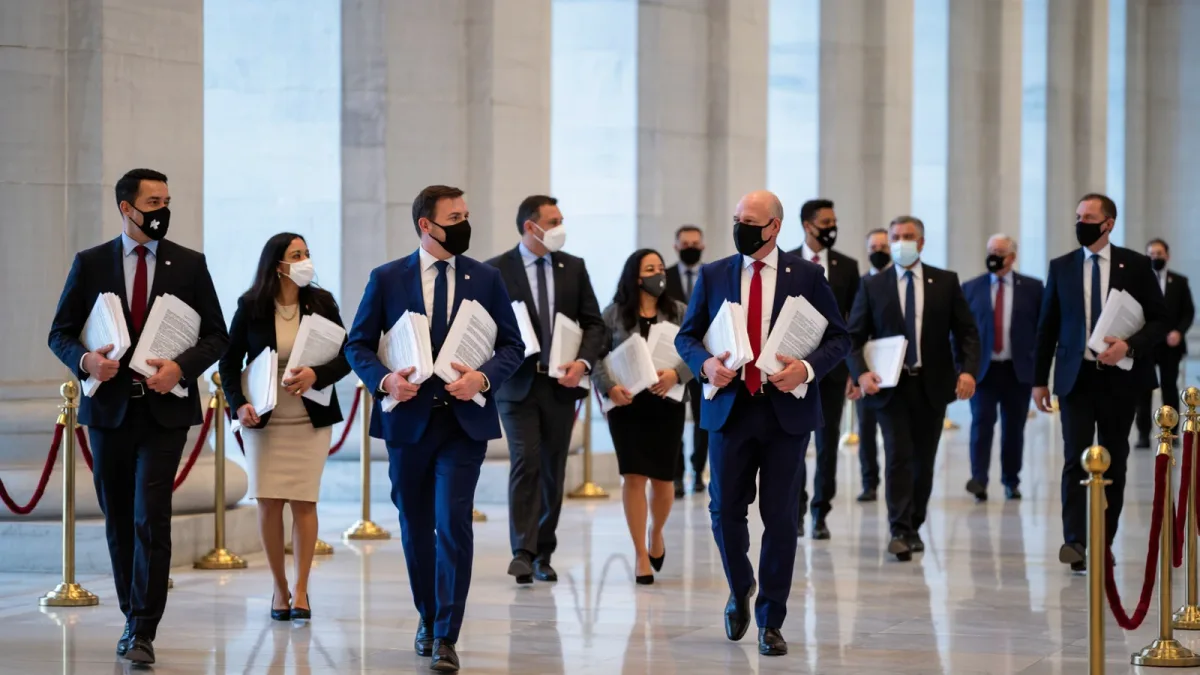
The fiscal 2026 National Defense Authorization Act became law on December 18, 2025, when President Donald Trump signed S. 1071 as Public Law 119-60, per the GovInfo record of the enacted statute. The Senate had cleared the final text the day before, 77-20, ending a six-month path begun June 9, 2025.
What Is the NDAA and What Does It Actually Do?
The NDAA is the annual authorization act that sets policy, program limits and troop strengths for the Department of Defense. An authorization creates legal permission and spending ceilings; it does not itself move cash, which requires a separate appropriations act.
The FY2026 measure, the 65th consecutive annual defense authorization, carried a heavy acquisition-reform theme, according to a December 22 Holland & Knight analysis. The firm notes the bill implemented provisions of the SPEED Act and the FoRGED Act and codified Executive Order 14265 on modernizing defense acquisitions.
How Did the Bill Move Through Congress in 2025?
The route ran through both chambers twice, because the final version was attached to a Senate legislative vehicle. The recorded votes tell the story.
| Date (2025) | Action | Vote |
|---|---|---|
| June 9 | Introduced in the House as H.R. 3838 | — |
| September 10 | House passage | 231-196 |
| October 9 | Senate passage of its own version, S. 2296 | 77-20 |
| December 10 | House agrees to S. 1071 | 312-112 |
| December 17 | Senate agrees to S. 1071 | 77-20 |
| December 18 | Signed into law (Public Law 119-60) | — |
What Were the Sticking Points This Year?
Two chambers with different drafts had to be reconciled into one text. The House version had passed on a largely partisan vote in September, while the December agreement drew 312 House votes, reflecting the usual end-of-year broadening as negotiators dropped contested riders.
Not everything survived: the Holland & Knight analysis highlights that reauthorization of the Small Business Innovation Research and Small Business Technology Transfer programs was omitted from the final bill, a gap many in the defense industry will watch in the next cycle. Quality-of-life provisions covering military pay, housing and health care were retained alongside the acquisition overhaul. The bill also addressed drone and counter-drone legislation, shipbuilding and maritime reform, munitions production and defense industrial base investments — a policy inventory that reflected two years of war-driven demand on the force and the industry behind it. Readers comparing the House and Senate drafts will find the final text tracks the Senate vehicle on most acquisition titles.
What Happens Now That It Is Law?
The authorization takes effect as the policy baseline for fiscal 2026, but the money question remains separate. Appropriations for the department are still working through their own track, so the programs the NDAA permits will spend only what appropriators provide. That division — permission in one bill, cash in another — is the design of the congressional budget process, not a defect in it.